

Seventy-two years after her death, her image continues to orbit editorials, collections, and cultural conversations with the same intensity with which she painted herself: frontal, adorned, and indomitable.
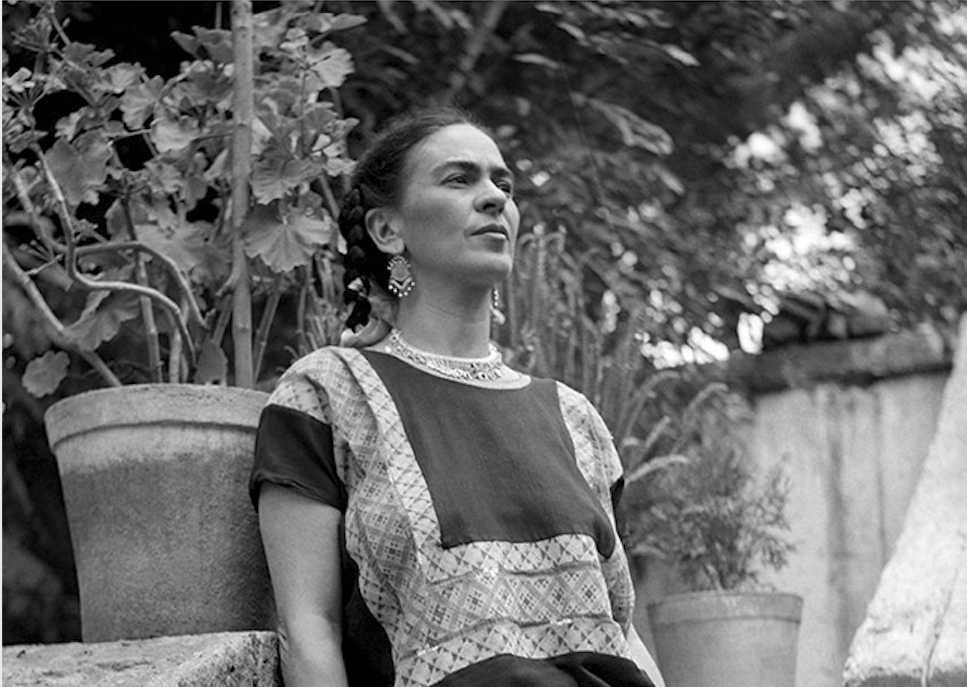
Before the concept of a “personal brand” existed, Frida Kahlo had already created her own. The meeting brows like a manifesto, flowers crowning braided hair, huipiles, and Tehuana dresses transformed into political statements and gestures of belonging. Her wardrobe was never mere ornament—it was narrative. Each garment amplified her discourse on identity, Mexicanness, and the body. It is no coincidence that designers and fashion houses continue to cite her as an inexhaustible visual reference.
In her self-portraits—more than a third of her output—styling is as significant as the brushstroke. Traditional dress converses with customized medical corsets, pre-Hispanic jewelry, and lush botanical backdrops. Physical pain, the result of accidents and surgeries, becomes aesthetic language; fragility turns into carefully orchestrated composition. Kahlo understood that getting dressed can also be an act of power.
Those who travel to Mexico City searching for her traces discover that her universe remains intact. The vibrant Museo Frida Kahlo, in Coyoacán, is not merely a museum: it is a chromatic manifesto. The saturated blue walls, embroidered textiles, accessories, and light-filled studio—everything feels arranged like a permanent set where life and mise-en-scène merge.
Her creative dialogue with Diego Rivera can be explored at the Museo Casa Estudio Diego Rivera y Frida Kahlo, where functionalist architecture and artistic passion coexist in a modern aesthetic that contrasts with the carefully constructed folkloric elements of her self-portraits. Meanwhile, the Museo de Arte Moderno recontextualizes her work within the broader narrative of twentieth-century art, confirming that her visual magnetism transcends trends.
The recent opening of the Museo Casa Kahlo expands the experience to her family roots, revealing how her intimate environment shaped the sensibility that transformed the personal into the iconic.
What keeps Frida relevant is not only her dramatic biography or her painterly technique but also her absolute command of self-representation. Kahlo understood that style can be resistance, that adornment can be armor, and that identity is constructed—and displayed—without asking permission.
In an era obsessed with authenticity, her legacy feels radically contemporary. Frida did not simply paint herself: she edited, framed, and ultimately became her own masterpiece.
And receive exclusive information to travel through Mexico in style!