
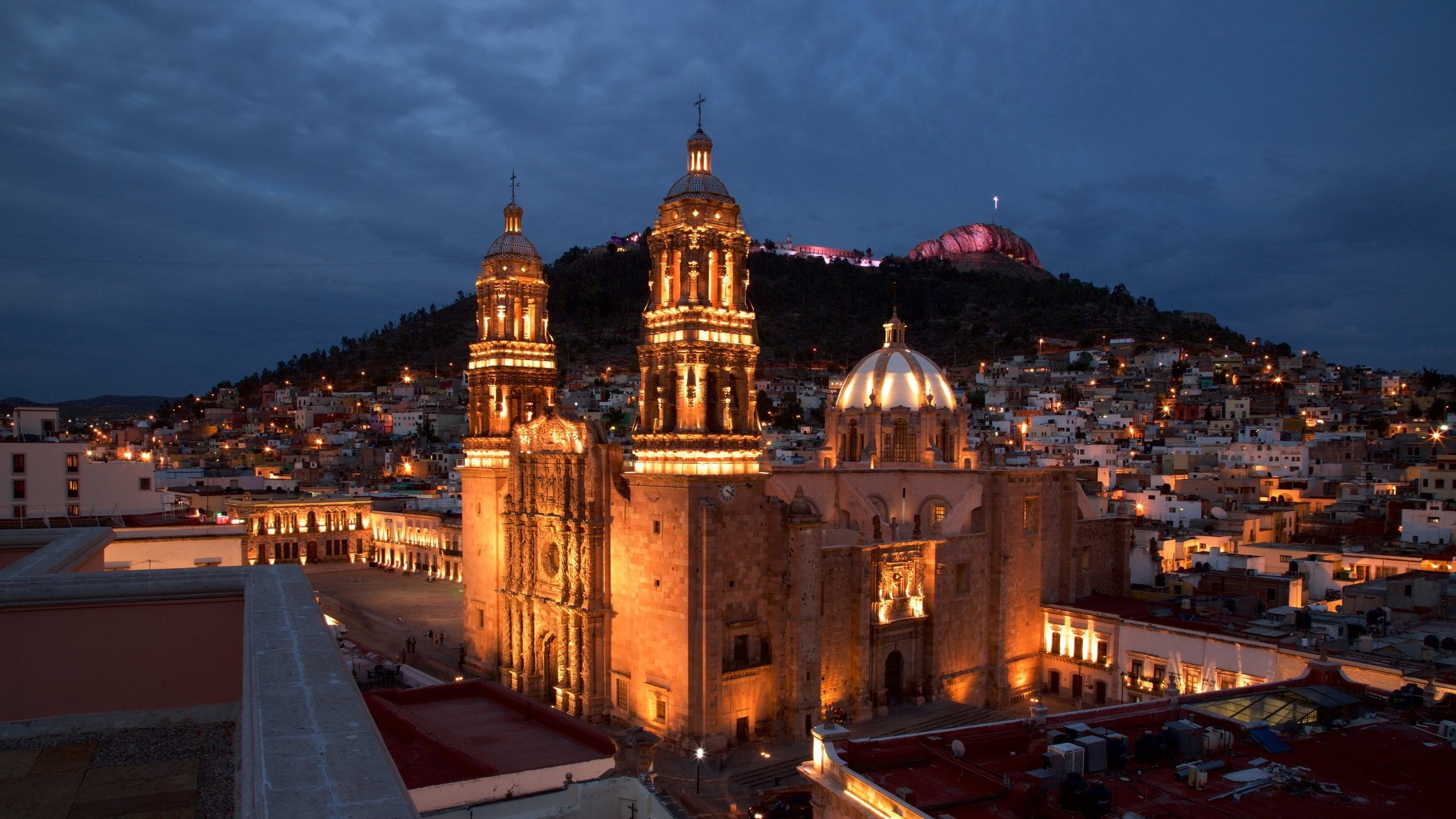

Founded in the mid-16th century thanks to its rich silver deposits, this city rose to become one of the most important mining centers in New Spain. Today, its urban layout—staggered, irregular, winding through alleys and slopes—and its buildings bring visitors back to that living memory, inscribed in pink quarry stone and in the glow that still seems to emanate from the subsoil.
The Cathedral of Zacatecas occupies a privileged place in the city’s landscape: built between 1730 and 1760, it visually dominates the plain at an altitude of 2,460 meters. It is a testament to the Baroque architecture of northern Mexico, where locally quarried stone takes center stage. According to researcher María Lorena Salas Acevedo, the building has three naves with stone-carved facades, carved with biblical passages and archangels watching over the historic center. This pink stone facade—a distinctive feature of Zacatecas—is not only ornamental but also a symbol of local identity and power. At dusk, its lighting highlights the relief and projects an atmosphere of solemnity that transcends the physical space.
If we look closer, we find the El Cubo Aqueduct—a late 18th-century structure that supplied the population until the early 20th century. Its long masonry arches glide like a dry stream that continues to sustain the urban landscape. There, the contrast between the hydraulic monument and the living city shows how colonial architecture was not only aesthetic grandiloquence, but also vital infrastructure. Each arch embodies the technique and ambition of a city that looked beyond its mines.
Although most of its monuments come from the colonial era, such as the Government Palace or the Temple of Jesus, the historic center of Zacatecas also shows traces of the 20th century: eclectic, art deco, and functionalist buildings that are part of the heritage perimeter. Recent research indicates that this architectural overlap poses conservation challenges, as many modern constructions do not fully recognize the value of the ensemble. Thus, the center becomes a scene of tension between memory, tourism, and urban development.
In Zacatecas, colonial architecture dialogues with the present. Every
stone, every arch, every alleyway tells a story of work, silver, faith, and
transformation. And it is this dialogue that makes the historic center
a place where architectural design and cultural heritage converge in
a masterful way.
And receive exclusive information to travel through Mexico in style!