
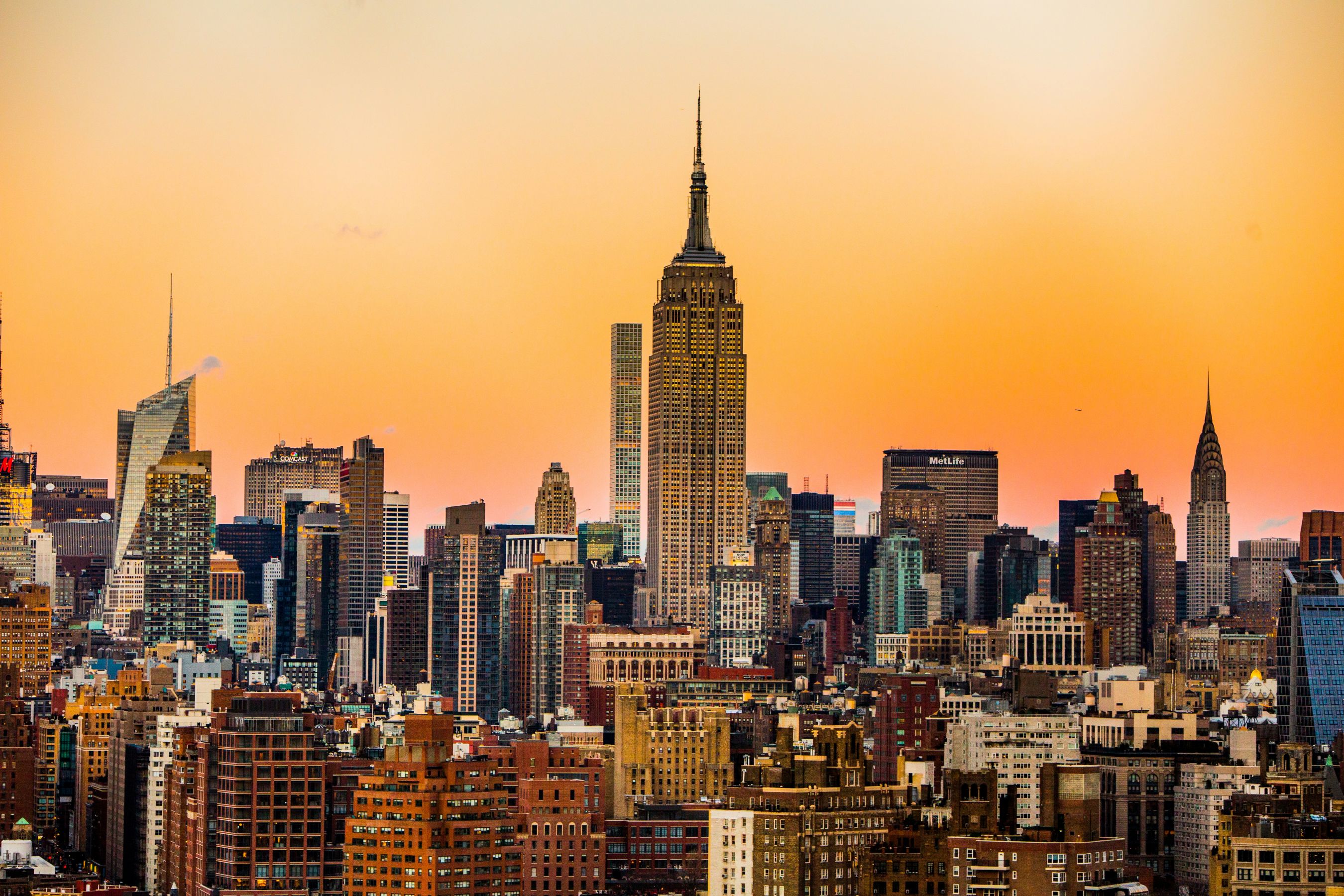

Some cities can be read in their streets. New York, on the other hand, is written in its skyline: a verse of steel and light. Those who observe it from afar perceive a history marked by the ambition to touch the sky. It does not seek harmony; it is built on tension, vertigo, and desire.
At the beginning of the 20th century, steel became the skeleton of New York, and verticality began to be its language. The Flatiron Building (1902) was one of the first to raise its gaze, followed by the Woolworth Building (1913), which brought the Gothic style to the business world.
In the 1950s, the Seagram Building (1958), designed by Mies van der Rohe, took minimalism to the extreme: glass, bronze, and proportion. The city became more abstract, with skyscrapers seeking transparency and control: an invisible order behind impeccable brilliance.
Today, the skyline is a spectacle for the senses. The floating architecture of Little Island and the suspended greenery of The High Line show that the city, once a symbol of corporate power, is also seeking to reconcile itself with its surroundings.
Seeing New York from the top of the Empire State Building is like feeling its rhythm from silence. The hustle and bustle fades away and the city reveals itself as a web of lights and shadows. Always changing: sometimes it transmits energy, other times calm, but it never stops telling its story in its own way.
In the 21st century, New York learned to look at itself. Glass is no longer just a material: it is also a mirror. Buildings such as One World Trade Center, the Hearst Tower, 432 Park Avenue, and the Vessel in Hudson Yards reflect the constant drive to reinvent itself and project modernity.
New York architect Gordon Matta-Clark cut into abandoned buildings to reveal their structure. Today, the skyline plays a similar role: it reveals the overlapping eras, styles, and changes that have shaped—and continue to shape—the city.
In Delirious New York (1978), Rem Koolhaas analyzes the city as a laboratory where fantasy, ambition, and architectural experimentation mix.
He calls it a
“laboratory of desire.”
And it probably is, but it is also a laboratory of
memory: every demolition leaves an echo, every new
tower raises a question
And receive exclusive information to travel through Mexico in style!