
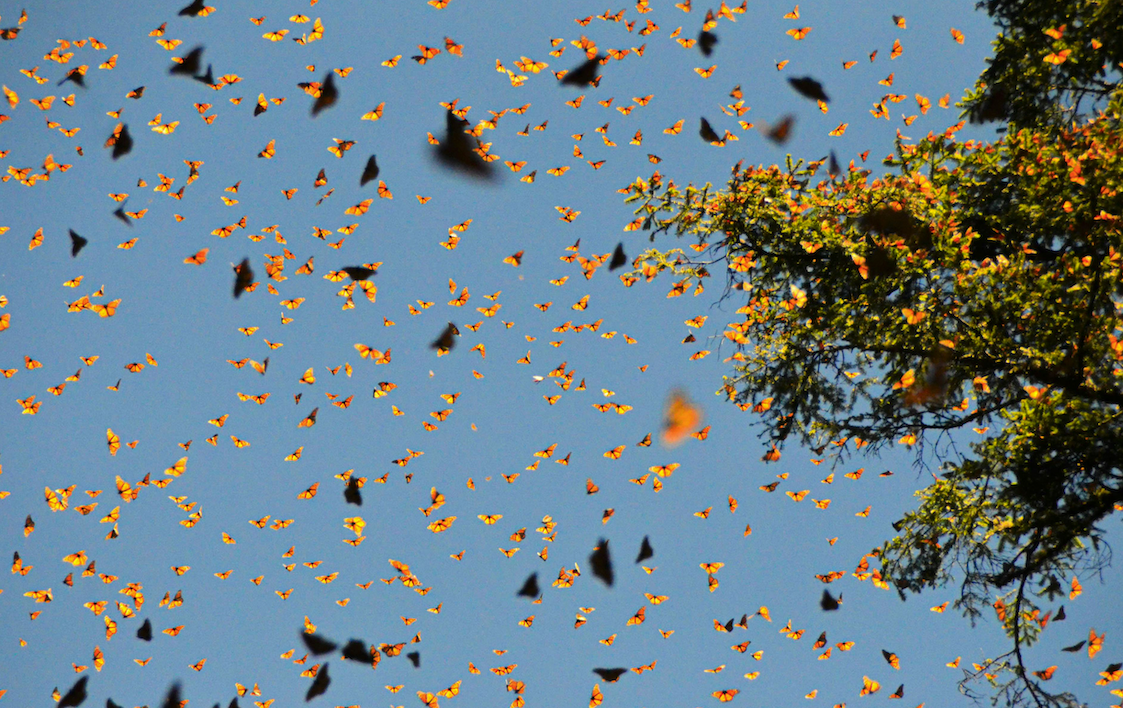

The air is cold and smells faintly of resin. It is just past eight in the morning when I begin walking uphill through the forests of Michoacán. The oyamel trees stand still, holding the silence of early winter. Then something shifts above me. It is not the wind. It is movement—thousands of monarch butterflies stirring at once.
Every year between November and March, this region becomes the endpoint of a journey that began thousands of kilometers north, in Canada and the United States. Monarch butterflies travel up to 4,500 kilometers to reach the Monarch Butterfly Biosphere Reserve, a protected area shared by Michoacán and the State of Mexico. Altitude, humidity, and forest composition converge here in a fragile balance that allows the species to survive the winter.
My first encounter takes place at El Rosario Sanctuary, near the town of Ocampo. It is the most visited site, and for good reason. From the main viewpoint, entire tree trunks appear coated in orange and black, as if the forest had grown a living skin. When sunlight reaches the upper branches, the butterflies release themselves into the air. The forest fills with motion, but not with noise—only the soft friction of wings.
A few days later, I walk the trails of Sierra Chincua, close to Angangueo. Fewer visitors make the ascent here, and the path is longer. The forest feels denser, more withdrawn. At certain points, monarchs move through the air in visible currents, flowing between trees. The altitude slows your breath, but sharpens your attention. This is not a place for haste.
The most remote experience comes at Senguio Sanctuary. Reaching it requires time and patience, and the reward is solitude. Butterflies share the landscape with streams, steep slopes, and quiet clearings. There are no crowds, no raised voices. Only the sense of standing inside a cycle far older than any road leading here.
Local guides—members of nearby ejidal communities—accompany every visit. They explain why touching the butterflies is forbidden, why silence matters, and how responsible tourism has become an essential tool for conservation. The experience is not passive observation; it is a lesson in coexistence between ecological systems and human presence.
Leaving Michoacán after witnessing the monarchs feels different from other departures. The journey leaves behind a simple understanding: some natural events cannot be rushed, staged, or consumed. They ask only that we walk slowly, look carefully, and accept that for a few weeks each year, winter can turn orange.
And receive exclusive information to travel through Mexico in style!