
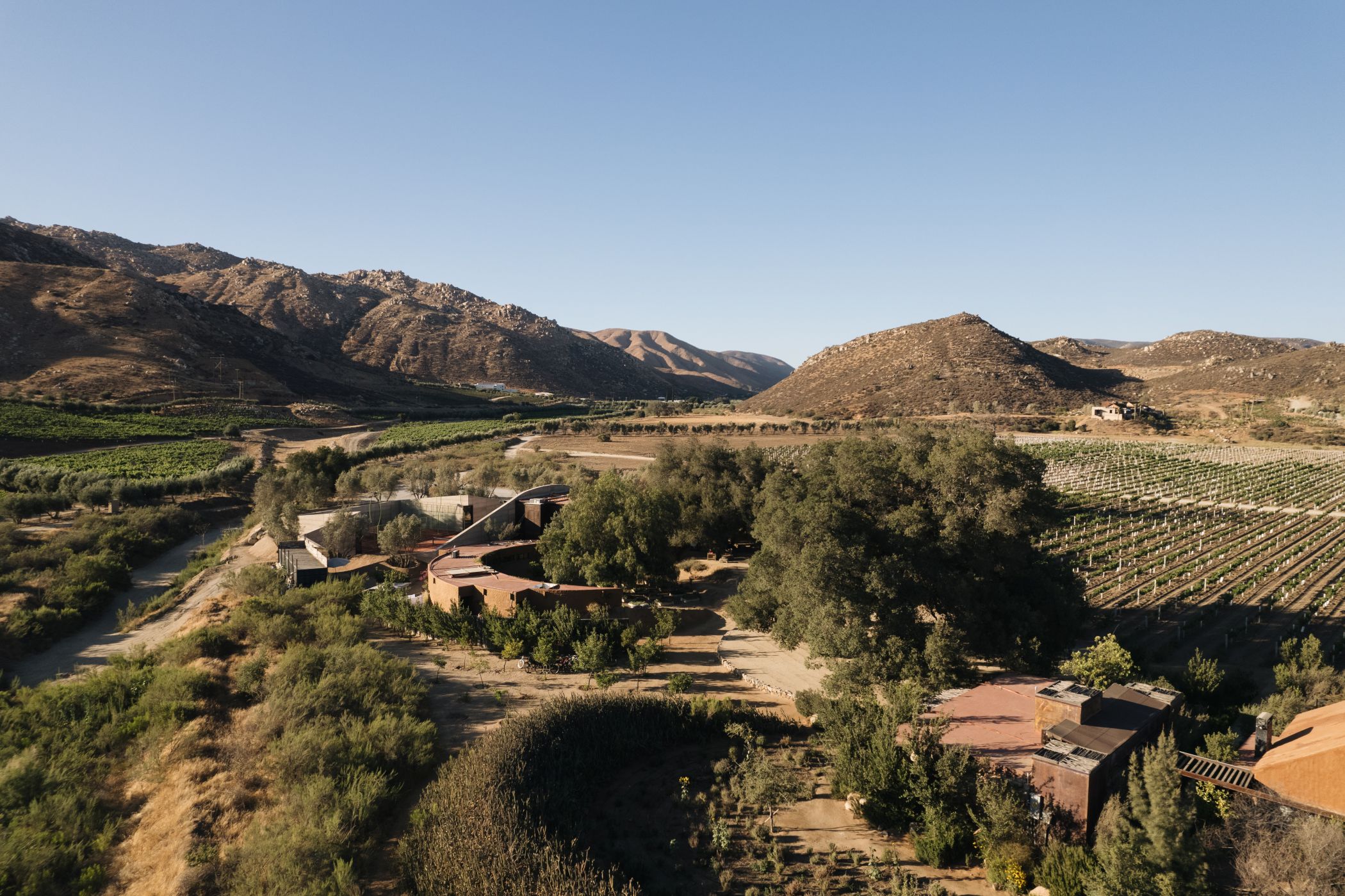

In the heart of the Guadalupe Valley, Baja California’s wine-growing region, architecture has become an essential part of the wine making landscape. Among the projects that stand out as paradigms of this new era are, on the one hand, the BRUMA Vinícola winery by TAC Taller de Arquitectura Contextual, led by Alejandro D’Acosta, and the wine complex designed by Garduño Arquitectos for the Monte Xanic firm.
BRUMA is projected as a barely perceptible object in the valley: its structure, made of recycled wood and steel, blends into the natural environment. A mirror of water above the underground cellar regulates the temperature without the need for mechanical inputs, while a hundred year-old oak tree becomes a symbol and support for the building. This approach to architecture, which does not invade but coexists with the vineyard, expresses a unique territorial and material sensitivity.
For its part, Garduño Arquitectos’ project for Monte Xanic draws on bioclimatic design strategies and local materials, creating a complex where water, mountains, and wine culture converge to narrate the cycle of the vine. The work offers an experiential journey that transcends mere production: visitors become part of the process, and the building becomes part of the landscape.
Other examples that demonstrate a transformation in
Baja California’s wine architecture, where it is not just
about production wineries, but facilities that speak of
the territory, the climate, the origin, and the culture of
Mexican wine.
Encuentro Guadalupe, by Graciastudio, features modular suites made of rusted steel and concrete suspended above the rocky terrain, a minimal gesture that allows visitors to “see without touching” the valley landscape.
But there is also Cuna de Tierra, by CCA, which translates Mexican wine-making tradition into a stone mass inspired by ancient agricultural towers, while Viñedo DeCote, by Serrano Monjaraz Arquitectos, explores contemporary geometry with pure forms and an open dialogue between interior and exterior.
Taken together, these vineyards are defined as a
movement that prioritizes integration with the
land, the use of local materials, and a poetics of
sustainability. More than just wineries, they are
manifestos of identity where architecture ferments
alongside the vines
And receive exclusive information to travel through Mexico in style!