
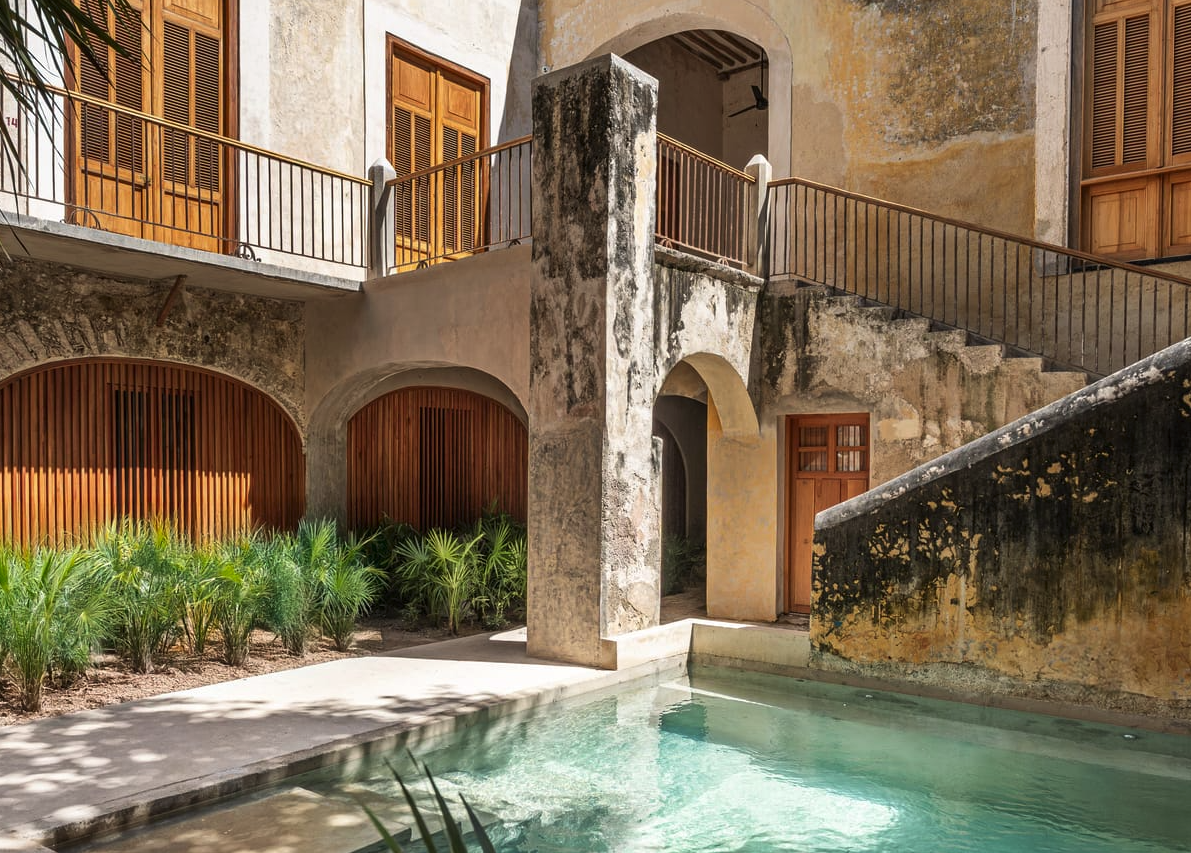

Hotel Sevilla, recently opened and owned by Grupo Habita, has joined the MICHELIN Key selection, offering a timely reason to discover this house, where the city’s history is reinterpreted through a different language of colonial walls, concrete, henequen, and wood.
The property occupies a 16th-century mansion that remained largely in ruins for years. Grupo Habita discovered it seven years ago and began a restoration process aimed at recovering its original structure. Interdisciplinary studio Zeller & Moye, together with Salomón Sacal, led the architecture and interiors, in an intervention that avoids a literal reconstruction of the past.
The first encounter with Hotel Sevilla takes place in a stone-and-whitewashed lobby. A window opens onto the central courtyard, where four almond trees frame the open-air Mexican cantina. It is one of the places where the hotel begins to blend with the rhythm of Mérida: the architecture leads into the common spaces, and those spaces, in turn, lead toward the city. A concrete spiral staircase leads to the bistro, which seats 24 guests.
French chef Marion Chateau oversees both dining concepts and also leads the kitchen at Hotel Humano, another Grupo Habita property in Puerto Escondido. Here, French-Mexican cuisine changes according to the fresh ingredients available at the nearby market. Breakfast and dinner follow the same seasonal approach, while the bar revisits classic cocktails made with Mexican spirits such as mezcal and tequila.
The 17 rooms and four suites differ in size and layout, but share the same palette. Polished black-toned ceramics, local woods, modernist-inspired furniture, lighting by Luca Salas, and henequen textiles define the spaces.
At the back of the property, the former horse stables have been transformed into a second, more secluded courtyard, with a concrete pool divided into two depths by an existing stone wall.
The same design language extends into the spa, where the inspiration comes from Yucatán’s ancestral wellness traditions. There is a Mayan Tuj sauna and a cold-plunge pool, as well as private and communal sessions. The latter are also available to outside visitors through an hourly pass. To extend the ritual, the hotel offers a kit containing sea salt, local mineral clay, a sponge, and an herbal infusion.
The treatment menu includes deep-tissue massage, reflexology, and cranial massage, with the option of having them performed in the room.
A MICHELIN Key is more than a distinction to add to a hotel’s name. It is also a way of identifying properties where architecture, a strong sense of place, service, and the overall guest experience carry particular weight.
At Sevilla, these elements are tied to a fundamental decision: not to separate the hotel from Mérida, but to build the surrounding experience. One block from Plaza Grande, travelers can step outside to find the Cathedral, Casa de Montejo, and the places where live music regularly fills the streets. Farther on are Paseo de Montejo and its historic mansions, as well as Mercado Lucas de Gálvez, where textiles, crafts, and agricultural products come together.
Then, upon returning, the city remains on the other side of the walls. The concrete, pool, courtyard, and spa offer a different scale in which to continue the day. This interplay between heritage and contemporary design is ultimately what makes Hotel Sevilla compelling: an old house in Mérida’s historic center that does not seek to stop time but to inhabit it differently.
And receive exclusive information to travel through Mexico in style!